
Qingming Festival: Dates, Traditions, and Why You Should Never Say “Happy Qingming”
What is Qingming Festival
Qingming Festival (清明节), also known as Chinese Tomb-Sweeping Festival, is a time when Chinese families honor their ancestors and celebrate the arrival of spring. It s not only one of the 24 Solar Terms (which is quite an interesting way of separating the seasons), it is also one of the four major traditional Chinese festivals. Since I covered the other three in The First Chinese Festivals picture book series, it’s time I write about the Chinese Tomb-Sweeping Festival as well.
Following the format of my picture books, let’s first talk about when it is, followed by the festival traditions, then the origin story, together with some interesting facts.
(I’m focused more on writing novels lately, but if you’re interested in seeing more Chinese festival picture books, please let me know in the comments below. It’ll definitely impact my decisions in the future.)
When is Qingming Festival
Qingming Festival (清明节), also known as Chinese Tomb-Sweeping Festival, is a time when Chinese families honor their ancestors and celebrate the arrival of spring. It takes place 15 days after the Spring Equinox, which falls on April 4th, 5th, or 6th each year.
Why is Qingming Festival not on a set date?
In China, Qingming Festival is a three day long holiday, which gives people enough time to travel (see Qingming Festival traditions below). Adjustments are made based on how close it falls to the weekend (unfortunately in a way that tries to give you a 3-day weekend instead of 5 days off, although maybe in 2029 people will get a lucky break).
Here are the Qingming Festival dates for 2026 and the next three years (because a table makes things clearer than just explaining with words):
| Year | Date of Qingming Festival | Day of Week | Holiday Period (Days Off) |
|---|---|---|---|
| 2026 | April 5 | Sunday | April 4 – 6 (Sat, Sun, Mon) |
| 2027 | April 5 | Monday | April 3 – 5 (Sat, Sun, Mon) |
| 2028 | April 4 | Tuesday | April 2 – 4 (Sun, Mon, Tue) |
| 2029 | April 4 | Wednesday | April 4 – 6 (Wed, Thu, Fri)* |
*Note: Dates for 2029 are projected based on standard holiday scheduling practices (adjacent days or weekend adjustments). Official announcements are typically made closer to each year.
This year, it happens to be on the same day as Easter Sunday (April 5, 2026), which is an interesting coincidence.
Bonus Language Lesson 🥚
In Chinese, Easter is called:
复活节 (Fùhuó Jié)
复活 (fùhuó) — resurrection / to come back to life
节 (jié) — festival / holiday
So literally, “Resurrection Festival.”
For more language notes and cultural deep dives, subscribe to my newsletter.
Qingming Festival Traditions
Here’s what families typically do on this day. (Because “celebrate” is the wrong word to use for this holiday–see What do you say to people on Qingming Festival below)
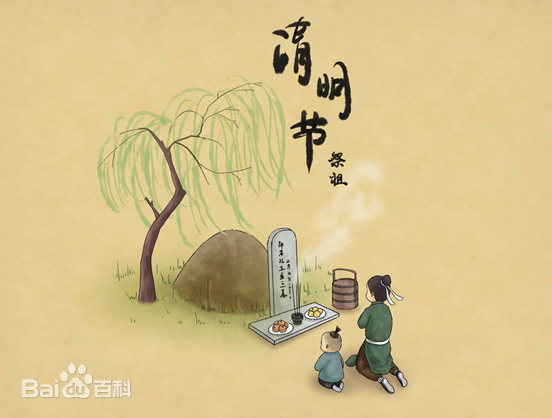
- 祭祖 (jìzǔ): Clean graves, offer food, burn incense, and pay respects to deceased family members and national heroes.
- 踏青 (tàqīng): Go on Spring outings (literally translated as “step on green”). People fly kites (often with strings cut to let go of bad luck), and wear willow branches to ward off evil (more on that below).
- 吃青团 (chī qīngtuán): Eat qingtuan, which is a sweet, chewy treat made of glutinous rice and mugwort juice, symbolizing the freshness of spring. (Each traditional Chinese festival is linked to a special food, Qingming Festival is no exception. If/when I publish the picture book, qingtuan be featured on the cover like the others.)

- Plant trees: Before it became Tomb-Sweeping Day, Qingming Festival was known as 植树节(Zhíshù Jié) or Tree Planting Day. The warm weather and rain of Spring makes it a great time to plant trees, and since the day became associated to mourning lost loved ones, planting a tree seems like a good way to honor them.
- Wear willow branches: People break off willow branches and wear them on their head, or attach them to the entryway or under the roof. It is now a way to pray for longevity. Before it was associated with longevity, people wore willow on this day to honor the oldest known prehistoric leader of China–Shennong (an amazing character that deserves his own blog post).
- Play traditional games
- 蹴鞠 (cùjū) — An ancient Chinese version of soccer (football for everyone else), played with a leather ball stuffed with feathers or hair. It was popular during the Han and Tang dynasties and is recognized by FIFA as the earliest form of soccer/football.
- 荡秋千 (dàng qiūqiān) — Literally “swinging on a swing,” with the noun swing being 秋 (fall) 千 (thousand). Swinging was traditionally a Qingming Festival activity, especially popular among women in ancient times as depicted in ancient scrolls.
- 击鞠 (jījū) — An ancient form of polo played on horseback (literally “hit ball” (archaic)). It was popular during the Tang Dynasty. The modern day translation for polo is now 马球 (mǎqiú), or “horse ball.”
Want to bring these Qingming traditions home? Here are some favorites to get you started.
(As an Amazon Associate, I earn from qualifying purchases.)
What do you say to people on Qingming Festival?
Although it’s called a “festival,” Qingming Jie is a solemn occasion for honoring ancestors and visiting graves. As you can imagine, it’s inappropriate to tell people “Happy Qingming!” (In fact, you should never say that!)
So what do you say?
The best course of action is actually not to say anything at all. A simple nod may do more for acknowledging others who are observing the holiday than what words can. If you have to say something, then maybe “take care” or “safe travels” would be nice.
The Origin Stories of Qingming Festival
I’ve put together a PG version of the story of the first Qingming Festival. The real story is a bit… complicated. It’s emotional, moving, based on true history, but not appropriate for children’s books. Still, it’s a story worth telling, so you can access it on my substack, where I also discuss why you won’t find it in Western children’s books, but somehow it’s ok for Chinese picture books and cartoons.
But for this blog, let’s keep it family friendly according to Western standards.
- How the Emperor Found his Parents–story of the origin of Tomb-Sweeping Day (to be posted before Qingming 2027)
- The origin of Spring outings (to be posted before Qingming 2027)
Want more content about Chinese culture?
Sign up for my newsletter: Journey to the East