Nüwa and the Creation of Humans
In our journey through Chinese history/mythology, we began with the legend of Pangu. Born from the cosmic egg of primordial chaos, he pushed the sky away from the earth. Then upon his death, his giant body became the world.
But Pangu did not create humans. That honor belongs to the goddess Nüwa (女娲).
Nüwa the legend, the myth, was built upon thousands of years of stories. And stories, the good ones anyway, tend to become more elaborate with each telling. They tend to transform to fit the narrative as society changes. Especially when it comes to creation myths, the emphasis is not on who did what when, but rather on how people wanted to explain natural phenomenons, and in this case, the origin of their very existence.
Instead of just telling the story as people know it today, I like to look at things in terms of how they came to be. And so, we’ll start at the very beginning, from the first mention of the name—Nüwa.
Subscribe to newsletter
Want email updates as we journey through Chinese history and mythology?
Subscribe to my newsletter: Journey to the East.
Nüwa as a clan name in matrilineal societies in prehistoric China
From archeological evidence1 and recent genetic studies2 we know that early prehistoric societies in China were matrilineal. In a world where one knows their mother but not their father, men would leave their birth place, marry into a different clan, while women remained within the settlement. Children inherited the clan name of their mothers. That’s how an ancient grave site used for more than 10 generations was discovered to have 100% matching maternal mitochondrial DNA, while exhibiting a diverse array of Y-chromosome DNA.
One such maternal lineage was the Nüwa clan (女娲氏), whose leader was called Nüwa. Her family name of Feng (风 “wind”) placed her among a greater network of matrilineal clans that were the direct descendants of the Suiren Clan (燧人氏 “fire-making people clan”). As the name implies, Suiren was the title given to the first person who figured out how to make fire.
Here’s where the legend gets a little blurry. The story passed down through much of Chinese history states that Suiren’s daughter Huaxu was Nüwa’s mother. Yet in modern stories, Suiren is thought to be Huaxu’s husband, and they are the parents of Nüwa and Fuxi.
Either way, in Chinese mythology, the relatively unknown goddess Huaxu is the mother of the creation goddess Nüwa. Whether Suiren (the fire-maker) was her grandmother or father, I guess it doesn’t really matter (especially since gendered pronouns weren’t even a thing till the 1920s). The main point is that most Chinese gods have their origins in real historical individuals, or a mashup of individuals. And as patrilineal society took over following the development of advanced agriculture, it became more important for even gods to have both a mother and father, instead of just mothers.
Interestingly, my mother’s family continued to be matrilineal until the revolution. As a family of imperial scholars with land, businesses, and generations upon generations of only daughters, there was no other choice but for men to marry into the family name. And yes, I myself have only daughters too. Though as a post-revolution child, I didn’t take on my mother’s name.
Prehistoric Names
The names of the earliest clans or 氏 “Shi” came into being in stages:
- Primordial Epoch Names: Names from the era when the world was still forming. These names represented the mythological clans at dawn of time rather than historical clans. They included 盘古氏 (Pangu-Shi), 天皇氏 (Tianhuang-Shi “Heavenly Sovereign Clan”), 地皇氏 (Dihuang-Shi “Earthly Sovereign Clan”), 人皇氏 (Renhuang-Shi “Human Sovereign Clan”), 五龙氏 (Wulong-Shi “Five Dragon Clan”)
- Invention Era Names: These early clans were named after their most significant cultural contribution, such as the clan that first built permanent shelters 有巢氏 (Youchao-Shi “Have Nest Clan”) or the clan that mastered fire 燧人氏 (Suiren-Shi “Fire-making People Clan”). These names were passed down through oral traditions, then written and compiled in historical texts through the millennia.
- Foundational First Clans: These are some of the earliest named maternal clans. Huaxu-Shi (华胥氏), for example, is explicitly named as the mother of both Nüwa and Fuxi.
- Later Political/Territorial Names: These names are often associated with specific tribes, leaders, or regional powers in the later legendary period, sometimes with a more “political” or territorial connotation. By this time the communal matrilineal societies have transitioned to patrilineal ones with more significant social hierarchies (as in some people began to own much more stuff than others).
The Legend of the Goddess Nüwa
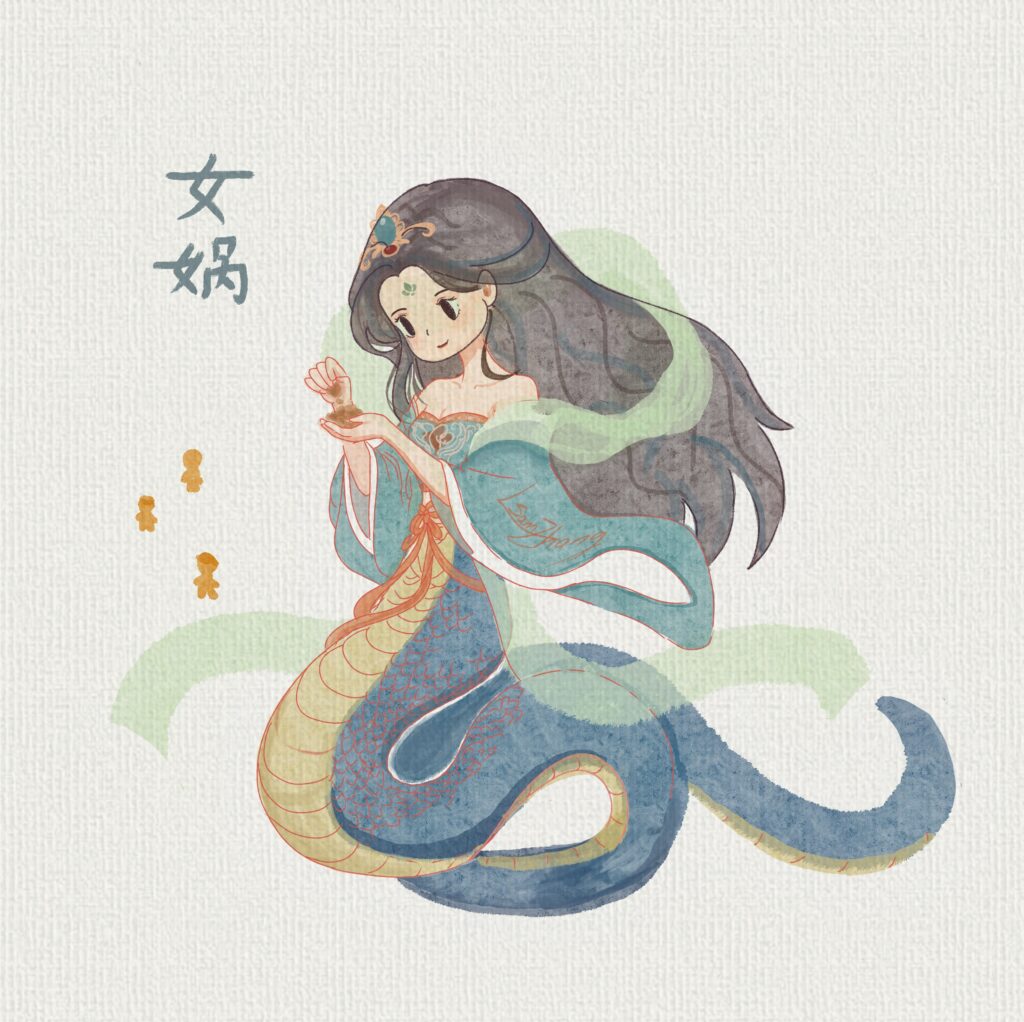
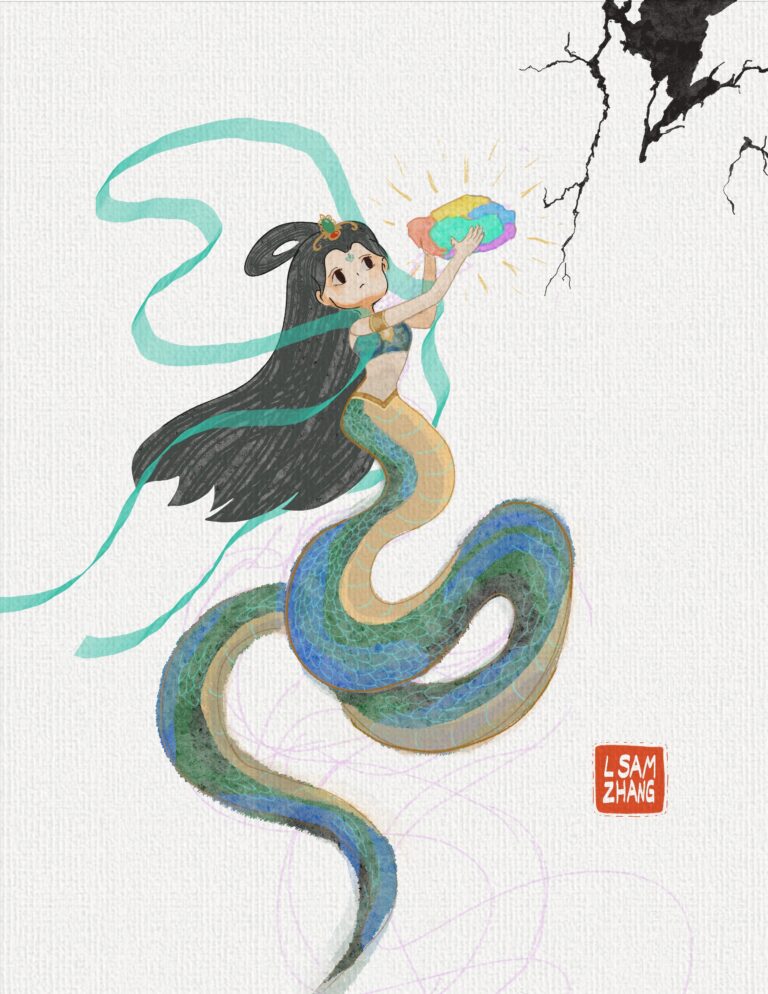
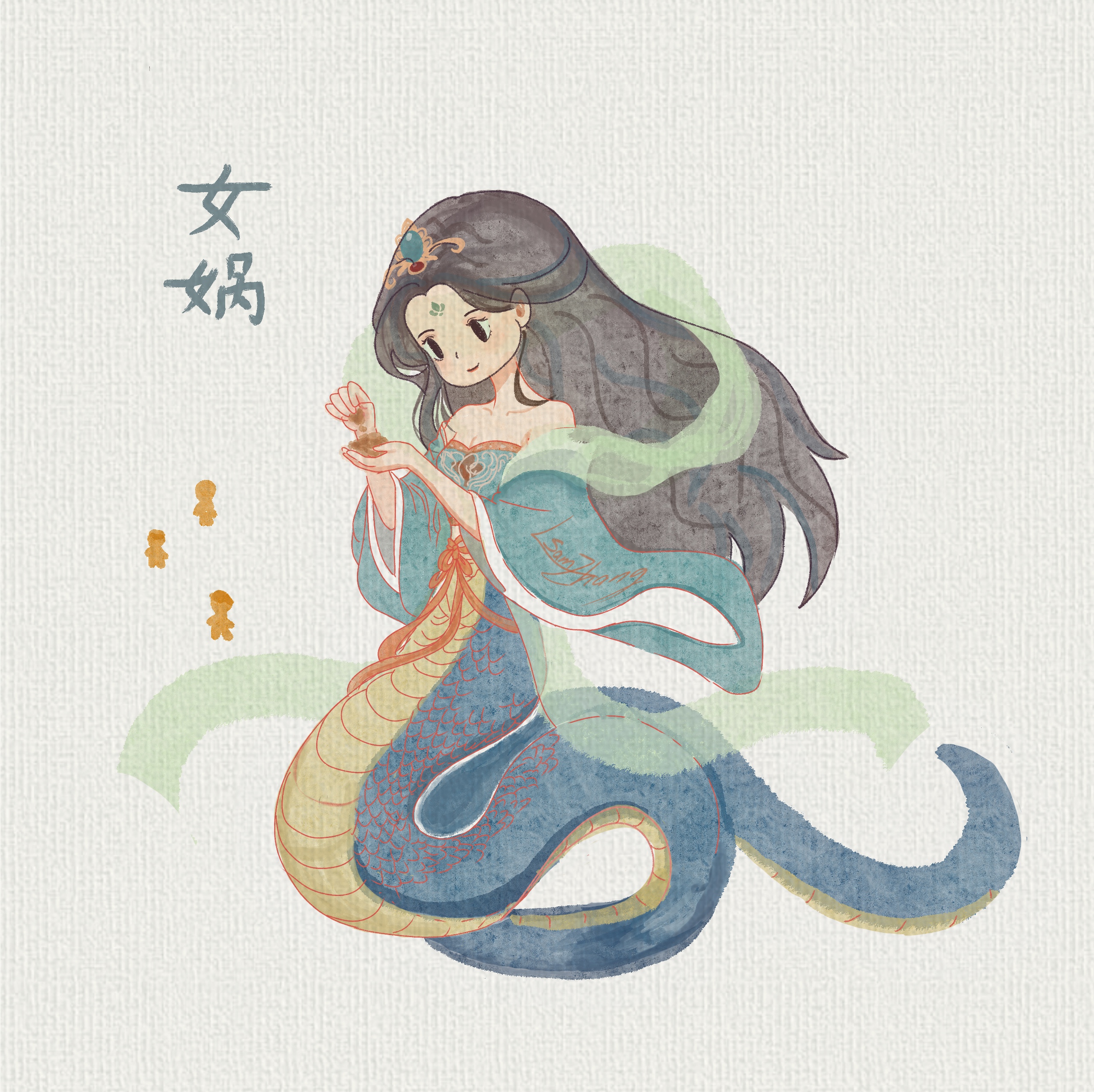
Nüwa was a being of immense power, depicted with the upper body of a woman and the lower body of a snake or dragon. She was first mentioned in the Classic of Mountains and Seas (《山海经》)3 for from her bowls, came ten divine beings who became gods in the western wilds. Her long serpentine lower half represented fertility, since longer the body, longer the bowels, and thus more fertile. (Her legends came before people figured out female reproductive organs.)
Through the millennia, the stories of Nüwa became more humanized. The widely accepted modern version goes like this:
In the new world (freshly risen from Pangu’s corpse), Nüwa wandered aimlessly in her beautiful surroundings. She was utterly alone. I like to think of her as a creative individual who got bored and sat by the river one day and started playing with mud. The official version however, set loneliness as the cause of human creation. And so, Nüwa knelt by the bank of the Yellow River, scooped up a handful of yellow clay and began to create some sort of companion. Looking at her own reflection, she carefully shaped the clay into a tiny being that looked like her (though for some reason she gave it two legs). The moment she set the figure down, it came to life, dancing and singing (because much like Frosty the Snowman, human psychology dictates that all inanimate objects that come alive must first sing and dance.)
Nüwa was delighted and named the creature “Human.” She worked tirelessly, making more by hand, but the process was too slow. Thus, she dragged a rope through the wet mud and swung it around. The blobs of mud that flew off became people of the lower order. Obviously, this part of the story came later as a way for the ruling class to explain the social hierarchy of their time, but the people Nüwa made by hand became the nobles and the wealthy, while the flecks of mud became the peasants and commoners. The simpler version where all humans were created equal is more widely told in China these days, though the social hierarchy version seems to be more widespread overseas.
As a responsible goddess, Nüwa didn’t just create humans, she also established the institution of marriage to ensure humans could reproduce on their own. Thus, Nüwa is also known as the Goddess of Matchmaking Gao Mei (高禖 “High Matchmaker”) responsible for marriage, love, and birth.
Her story doesn’t end there. She went on to save the world when she patched the sky after the great flood. We’ll explore that exciting story next week. But since we’re on the topic of marriage, I can’t end this article without talking about Nüwa’s marriage to her brother Fuxi (伏羲).
Nüwa and Fuxi
Fuxi started out as an individual completely separate from Nüwa. He was one of the Three Sovereigns,4 credited for having taught the people how to hunt and fish. He was also the one who established The Eight Trigrams (八卦) system of divination, which is a central concept in Chinese traditional medicine, psychology, and martial arts.
Starting from Han dynasty (202 BC to 220 AD), Fuxi and Nüwa’s stories began to mix. Writings emerged that described how Huaxu stepped in the footprint of a giant, then gave birth to Fuxi and Nüwa. Just like that, the two early prehistoric leaders became siblings. At around the same time, tale of their marriage got introduced as well. Following the great flood, Fuxi and Nüwa were the only ones who remained on earth. For some reason, instead of crafting more people from mud, the two of them had to marry in order for humanity to procreate. (I guess all the magical creation mud got washed away in the flood.) Like I wrote earlier, it became important for humanity to have both a mother and father, and so, Fuxi was recruited as the father figure.
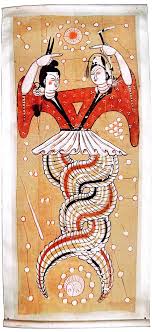
From then on, images of Fuxi and Nüwa as a bonded pair appeared in wall paintings and prints. They are often depicted as two intertwining snakes with human upper bodies. Coincidentally, this ancient imagery looks very much like modern depiction of DNA strands. Combined with the fact that Nüwa is the goddess of birth, with her and Fuxi being the parents of humanity, there’s a lot of talk online lately on the pair being the first ancient depiction of the DNA. But like with the great flood, most ancient civilizations have intertwined snakes as a symbol of life or medicine. Whether that’s a coincidence, some general human psychology, or alien involvement, I’ll leave that up to you to decide…
- Most notably the Banpo (半坡 “half slope”) and Hemudu (河姆渡 “river mother shore”) communal cultures dated six to seven thousands years ago. ↩︎
- Wang et. al. (2025) Ancient DNA reveals a two-clanned matrilineal community in Neolithic China. Nature, 643, 1304–1311. https://doi.org/10.1038/s41586-025-09103-x ↩︎
- A fantastical ancient Chinese geographical and mythological text, compiled from oral traditions passed down before the days of written language. It blends real topography with accounts of mythical creatures, deities, and shamanistic practices in a highly unsystematic yet encyclopedic fashion. Modern counterparts of some of the creatures and locations described can be found across the seven continents. The passage that mentions Nüwa is in Chapter 16, Outside the Great Wilds – West Chronicle (《大荒西经》). ↩︎
- Legendary sage-rulers of primordial China. Most often spoken of in combination with the Five Emperors (三皇五帝). They include Fuxi (伏羲) who invented writing and fishing, and Shennong (神农) who invented agriculture and herbal medicine. Who the third sage-ruler is depends on the context: Sometimes it’s 黄帝 (Huangdi) who is more commonly considered the first of the Five Emperors. Other times it’s Nüwa, or Zhurong (祝融) the fire god. ↩︎