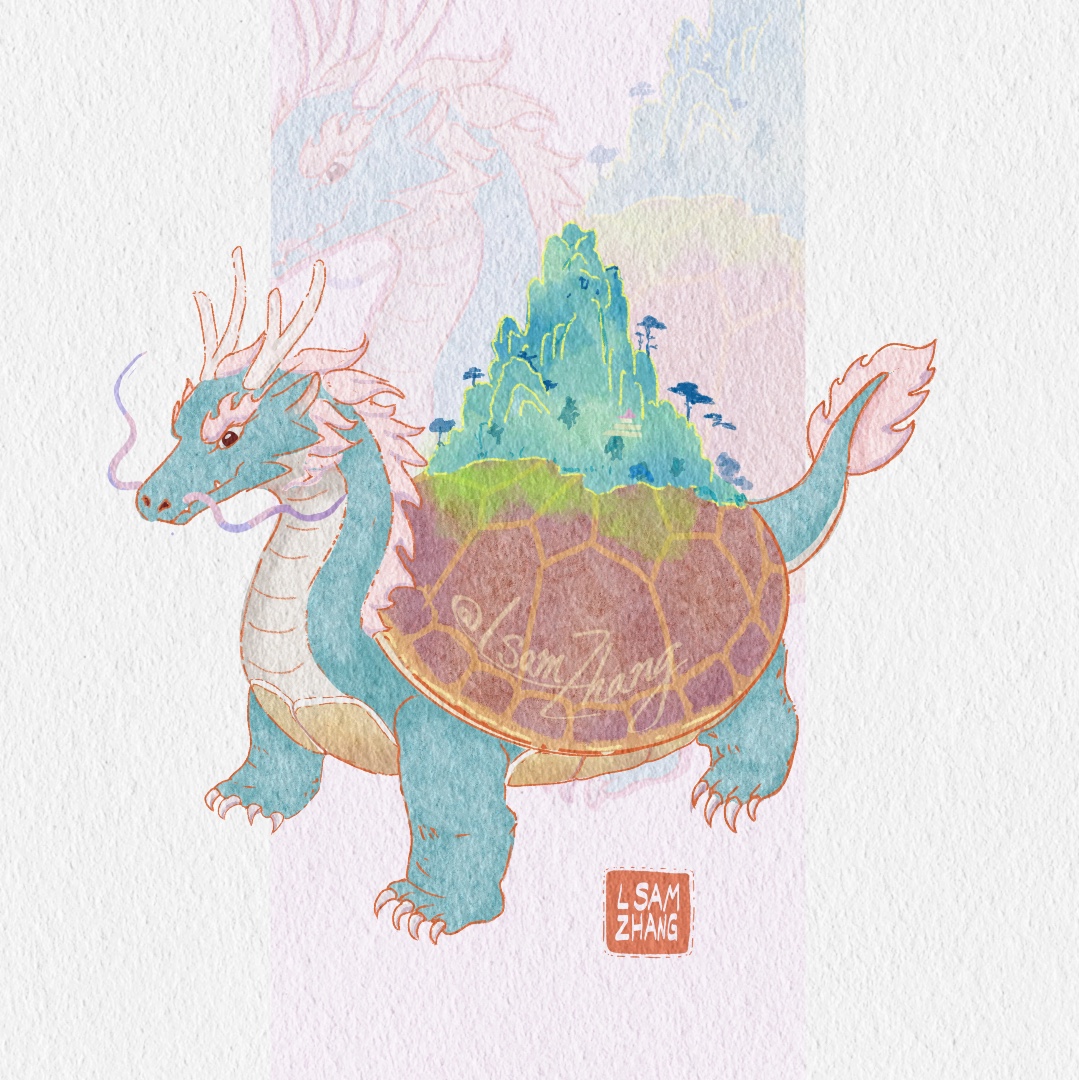
The Primordial Turtle Áo (鳌)
Summary: Fruit of immortality, lost mountains of paradise, and the death of more primordial turtles after the real answers to life, universe, and everything.
In my last article, we talked about how the sky is held up by turtle legs. This is not like in Terry Pratchet’s Diskworld where the land is carried on the back of a giant space turtle with elephants sandwiched in between. In Chinese mythology, the legs of the turtle were cut off and made into posts. (That way you won’t risk any irresponsible weight-baring parties to just quit and run off one day.)
This time, we’re going to learn a bit more about these giant primordial turtles called Áo (鳌). In addition to one particular individual’s legs being used as the pillars of heaven, these giant Áo turtles were involved in another legend. Though in the end, things didn’t turn out well for them in that story either.
This story originates from Lièzǐ, a Daoist text from the Warring States period (5th century – 221 BCE) that contained many stories about immortals. These interesting allegories were later taken literally by followers of the text (much like a certain western collection that became the best selling book in history…). This led to a quest for immortality that became rooted in Chinese culture as a real possible human achievement. (Ironically, such a quest led to the death of the most famous of emperors. Can you name him? Hint: he has to do with terracotta warriors.)
Anyway, in the text, King Tāng—the guy who established the Shāng dynasty when he overthrew the tyrannical King Jié of the Xià dynasty—asked his minister Xià Gé a bunch of ridiculous profound philosophical questions that dealt with the very nature of existence, time, and the infinite scale of the universe. Surprisingly, his minister had an answer to such questions that were apparently not 42.
Here’s a summary:
Q: Did matter exist at the beginning of time?
A: The universe has no absolute beginning or end. If there were no things in the past, there could be no things now. A beginning can become an end, and an end can become a beginning.
Q: Do the eight directions have an end?
A: Infinity and finitude coexist. Where there is nothing (emptiness), there is no limit. Where there are things, there is an end. However, beyond the limitless, there is even no “limitlessness” to speak of.
Q: What exists outside our known world?
A: The rest of the world is like our “Central State.” Tāng demands proof. Xià Gé explains that based on his travels, people to the east and west are the same as those in the middle lands. Therefore, the universe is likely a recurring, infinite system.
Q: Is our Heaven and Earth the only one?
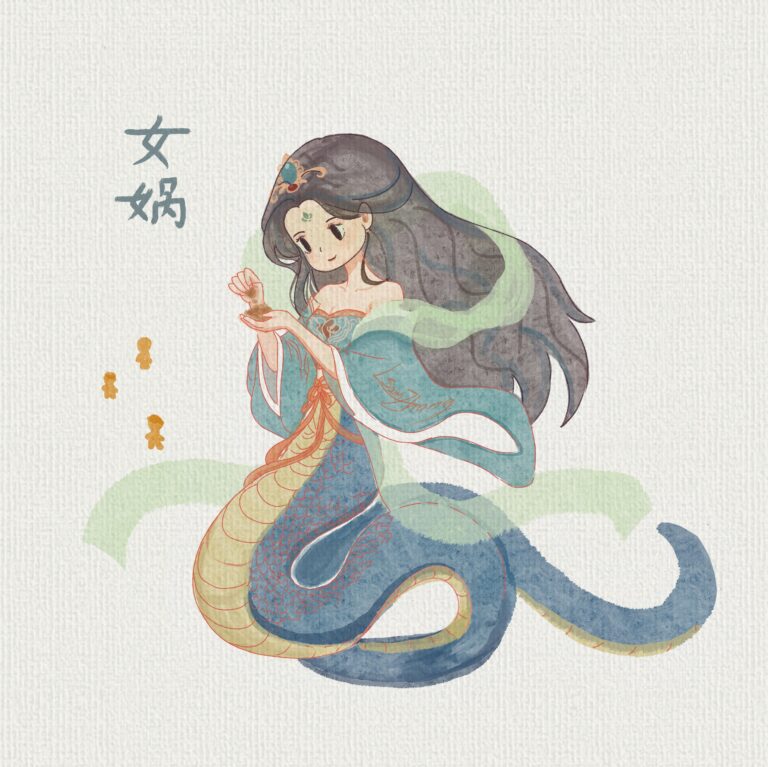
A: Our universe is a “thing” and has flaws. Just as our world contains smaller things, there may be a “greater Heaven and Earth” containing ours. To prove that “things” have flaws, Xià Gé cites the myths of Gong Gong breaking Mount Buzhou and Nüwa patching the sky, which caused the current tilt of the heavens. (Xià Gé then describes how the sky is tilted, so I guess this was after Nüwa patched the sky, but before she chopped off the legs of the Áo turtle to straightened the sky.)
Tāng then asks: Do things have size? Do they have length? Do they have similarity and difference?
This is when Xià Gé tells the story which involves the demise of more áo turtles.
The Five Floating Mountains of Paradise
Far, far away, to the east of the Bó Sea, there was a bottomless ravine into which all the waters of the world flowed. Floating in that body of water were five mountains. These mountains had golden pavilions, pure white animals, and zhūgān trees that grew in clusters. What are zhūgān trees you ask? Well these trees bore pearl-like fruits that were not only delicious, they granted eternal youth and immortality to those that ate them.
The people who lived on these mountains were the descendants of immortals and sages. They flew around and enjoyed carefree lives upon these mountains of paradise.
Well, almost carefree. No matter how good things are, people always find something to complain about. In this case, because the mountains were floating like giant cruise ships, they would rise and fall with the tides, unable to remain stationary for even a moment. The immortals and sages complained about it to the Emperor (the Supreme Deity). The Emperor became concerned that the mountains may drift to the Western Extreme and fall off the edge of the world. So he ordered fifteen giant Áo turtles to hold up the mountain with their heads.
The arrangement went like this: The turtles were divided into groups of three. Each group held up one mountain. (Supposedly using their heads?) They got to rotate shifts every 60,000 years. That’s a long shift to be holding something like a whole mountain, but at least it’s not forever. As anyone with a three legged stool knows, three supports provide the most stable of foundations. Thus the five mountains stood firm and did not move in that bottomless sea.
You’d think a long shift of heavy labor is bad enough for the turtles, but this is just the set up to the real tragedy.
Now in the country of Lóng Bó (龙伯; lit. dragon uncle), there lived giants. One of these giants took a few steps and ended up in the place of the five mountains. With one cast his line, he caught six turtles at once. He then carried them back home, probably ate them, and used their shells for divination.
That random day trip resulted in devastation for the inhabitants of the five immortal mountains. With six turtles gone, two of the mountains (Dài Yú and Yuán Qiáo if you must know) floated off to the North Pole and sank into the sea. Displaced immortal residents numbered in the hundreds of millions.
The Emperor was furious. He shrank the country of Lóng Bó along with its people. In the time of Fú Xī and Shén Nóng, the people of Lóng Bó measured only ten zhàng tall, which converts to 110 feet. Just imagine how big they were before they shrank!
But really, who’s at fault here?
And what a strange answer to a question on if things are different from each other. I guess that means the answer is yes… things come in different sizes and shapes….
As for the Áo turtle, there’s a reason why they have the head of a dragon, the body of a turtle, and the tail of a Qilin (a mythical hooved creature, spelled Kirin on the Japanese side). They are supposedly a member of the royal family of the dragon clan.
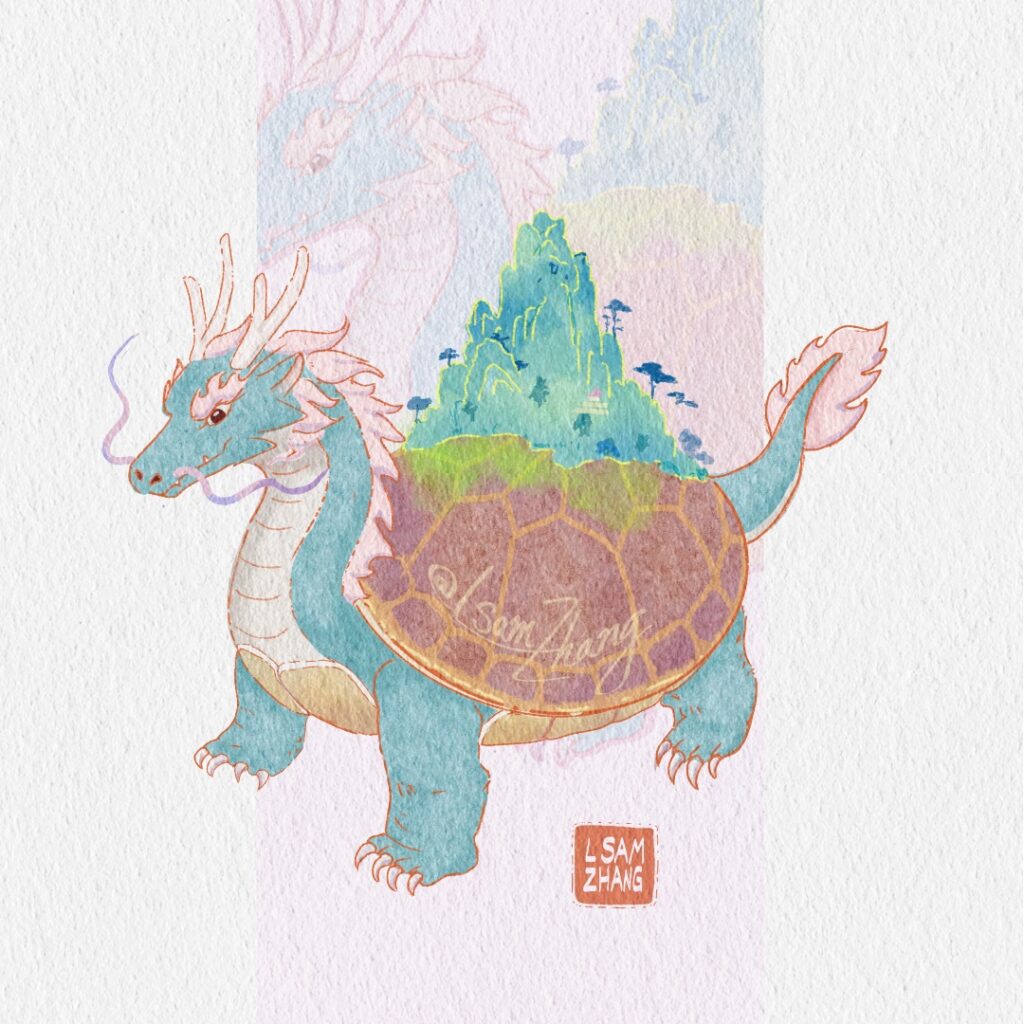
Origin of the Áo Turtle
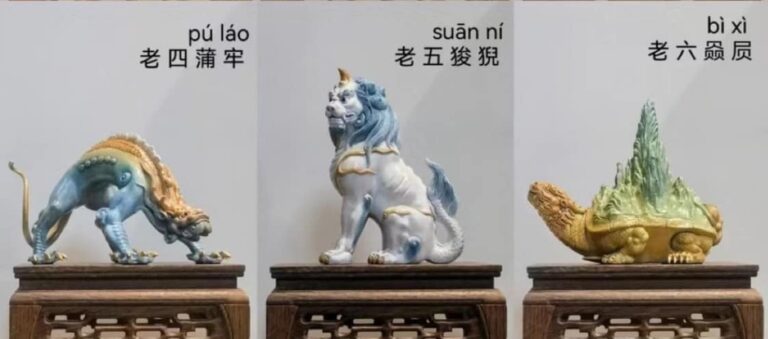
The Dragon King is known to have nine sons (龙生九子). Each comes from a different mother of a different species. I guess daddy dragon was bored or something, he kept trying new animals to see what would happen when you mix it with a dragon. The first animal he tried it on with was a turtle. This first born son Bìxì (赑屃) is the dragon-turtle famously seen carrying a heavy stone stele (memorial tablets) on its back in temples and imperial tombs across East Asia. That’s why modern depictions of the Áo is shown to carry the mountain on their backs like how Bìxì carries steles, as opposed to on their heads.
Language Link
Let’s end this article with a language link to yet another Chinese idiom.
We’ve already got 龙生九子 (lóng shēng jiǔ zǐ) which literally translates to “dragon bares nine sons.” It deserves it’s own article later on.
Here’s one specific for the Áo:
独占鳌头 (Dú zhàn áo tóu) – To stand alone on the Áo’s head.
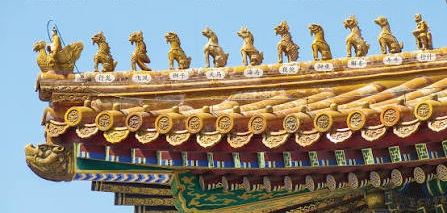
In imperial times, officials in the Forbidden City would stand on the steps in front of stone statues of Áo. Only the top scoring scholar (状元 zhuàngyuan) in the national civil service exam was allowed to stand on the very spot where the Ao statue was located. Therefore, to “stand on the Áo’s head” became synonymous with coming first, achieving the highest scholastic honor, and being the best of the best. (Yes, Chinese bureaucracy has historically been based on meritocracy. That’s why even today, the top Chinese political positions are held by PhDs).
The Áo itself on the other hand, while being associated to great things, continued to be taken advantage of and sacrificed in stories. They remind me of Sisyphus and Prometheus in Greek mythology, where their greatness is defined by their suffering.